The Cost of Machine Comprehension
Why flat-rate AI developer tools gave way to usage billing, and the economics of agent traversal.

Lead Software Engineer & Systems Architect
- Why the marginal cost of AI compute diverges from traditional zero-marginal-cost SaaS.
- How multi-file agentic loops trigger margin inversion for AI platform providers.
- The unexplained 10x cost variance observed across identical engineering tasks.
The Economics of Machine Comprehension Part 1 : Why usage based billing was inevitable
The software industry has recently encountered an economic hurdle that defies current models of infrastructure planning and cost projection. The era of flat-rate AI consumption came to an abrupt end, leaving behind a wake of fractured financial projections. Organizations and teams that built their entire engineering workflows on the expectation of infinite, subsidized AI services are now facing rigid financial constraints which manifested as hard AI usage quotas, sudden board-level budget reviews, and an ROI scrutiny. As engineering departments across the industry review their exhausted AI vendor budgets, the prevailing consensus is that they are experiencing a classic bait-and-switch business practice as vendors are recouping their capital expenditures during customer acquisition.
However, through this investigation, we will explore a different possibility. The data collected during this experiment points to a far more complex structural discrepancy. As the true cost of AI inference becomes visible on the balance sheet, an operational question arises regarding the consistency of that cost. When two distinct engineering teams are tasked with building nearly identical features, utilizing the exact same foundational models and identical agentic deployment tools, why do they experience drastically different consumption rates? The token burn rate of one team can exceed the other team by multiples, suggesting that something fundamental within the current economic equation remains entirely unaccounted for by traditional forecasting methods.
Through this series we will go on a rigorous investigation into how artificial intelligence interacts with the economics of software engineering. The central objective of this research is to determine whether the physical, architectural structure of the software repositories currently being built has acquired a new economic dimension. This research investigates whether the structural topology of a codebase imposes a direct, and measurable financial cost on machine comprehension, therefore introducing a variable that existing industry measurement tools are currently blind to.
The End of the AI Subsidy Era
On June 1st of 2026, AI-assisted development across the global software sector encountered a sudden speed bump. Copilot, alongside several major foundational AI model providers, moved beyond its original flat subscription model and introduced usage-based billing tied to token consumption volume. By charging organizations for the literal volume of tokens their integrated tools consume during execution, the platform altered the baseline mechanics of how engineering teams interact with the AI tools. There were tons of discussions on tech forums about the pricing shift and its effect, and the discussions that had previously focused entirely on driving rapid technological adoption, improving developer productivity, and exploring new capabilities abruptly shifted towards strict financial governance, token rationing, and tips and tricks to preserve the spending limits.
The financial fallout of this transition materialized at the enterprise scale as recent industry reports highlighted that tech giants like Uber exhausted their projected 2026 AI infrastructure budgets in a mere four months period, and this serves as an early indicator of a wider systemic issue. These immediate budget overruns forced the implementation of strict $1,500 monthly spending caps per employee, therefore bottlenecking the development pipelines they were meant to accelerate. While specific vendor pricing tiers and the absolute cost of individual tokens will inevitably fluctuate as the market matures, these high-profile events reveal a much broader structural trend. When enterprise organizations begin burning through annual software tooling budgets in a matter of months, it provides a signal that the underlying consumption curve of AI inference has disconnected from the historical software licensing models the industry currently relies upon.
Figure 1.1
Enterprise Budget Exhaustion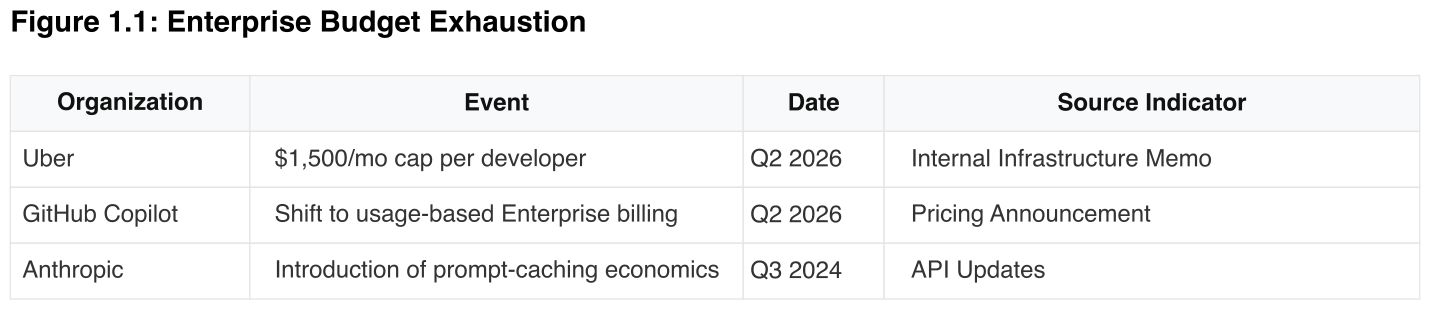
This economic reality had been operating in the background throughout the entire initial adoption phase, but they were disguised by aggressive vendor subsidies. If we examine the computational expense required to run modern, context-aware developer tools, and the cost of operating data centers that support these tools, the shift towards usage-based billing becomes understandable from a provider perspective. Vendors spent years subsidizing massive, unprofitable inference costs to drive early market penetration and establish user dependence. By shielding the end-user from the true cost of computation, they masked the fact that the underlying token consumption was always scaling at an unsustainable rate. Engineering teams simply grew accustomed to operating in an environment of artificial abundance, where the profound cost of forcing a machine to comprehend millions of lines of code was subsidized by the providers.
Now that the monthly invoices accurately reflect the true computational expense of inference, the engineering behaviors and repository management practices normalized during that period of artificial abundance are facing severe financial pressure. To understand exactly why development teams are suddenly burning through their allocated budgets at an unprecedented rate, it becomes necessary to step back and examine what physically changed in the underlying economics of machine inference, and why these new economics diverge so radically from any infrastructure scaling model the software industry has ever encountered before.
The False Equivalence
When the major AI vendors abandoned their flat-rate subscriptions, a predictable, and almost reflexive narrative emerged across the broader engineering community. The vast majority of industry observers and financial analysts assumed this was simply the execution of the standard software-as-a-service business playbook. The underlying assumption was straightforward and historically grounded: well-funded vendors subsidize a revolutionary product to aggressively capture market share, build deep operational dependence within enterprise workflows, and subsequently transition to a metered usage-based model to extract maximum revenue once the user base is effectively locked into the ecosystem. We’ve seen this with many SaaS businesses before. This assumption is a dangerous false equivalence because it misinterprets the physical, mathematical economics of machine inference.
In a traditional software business model, the marginal cost of serving an additional user predictably approaches zero as the overall system scales up. Consider a standard, well-architected microservice running on a major cloud infrastructure provider. Executing a standard API request requires a highly calculable, deterministic amount of memory allocation and compute duration, typically costing fractions of a penny to execute. As the active user base grows from one thousand concurrent users to one million, the baseline infrastructure cost per individual user steadily declines due to resource pooling and operational efficiency. The economics of scale favor the vendor. This predictable dynamic explains exactly why traditional SaaS companies can afford to maintain flat-rate pricing indefinitely. Their operational costs stabilize and flatten out, while their recurring revenue continues to grow linearly with every new subscriber they acquire.
Machine inference compute shatters this established economic pattern entirely because the cost per execution does not stabilize in the same way. As users grow accustomed to the capabilities of the technology, their interaction behavior naturally evolves toward greater complexity. The technology also evolved as developers transitioned from asking a model to autocomplete a single isolated line of code to instructing an autonomous agent to traverse, map, and modify an entire enterprise repositories. The financial difference between these two operations is quite huge. A basic, localized autocomplete prompt consumes roughly thousand tokens, costing a vendor approximately one single dollar per one thousand executions. When developers deploy robust autonomous frameworks like Claude Opus through Co-pilot or SWE-Agent or OpenHands to resolve complex, multi-file repository issues, these agentic workflows routinely consume between 1.5 million and 3.8 million tokens per resolved issue. The compute cost required to execute the workload can escalate quite a lot from a single dollar to over thousand dollars for the exact same volume of engineering tasks.
As the engineering workflow matures and the required context window inevitably expands to encompass more of the codebase, the unit economics collapse. The compute required to process the intricate tasks within that window scales quadratically rather than linearly. The inference scaling curve demonstrates mathematically that the transition to usage-based billing represented a strict necessity to survive rapidly inverting profit margins, rather than a strategic business switch designed purely to maximize corporate profit.
Figure 1.2
The Margin Inversion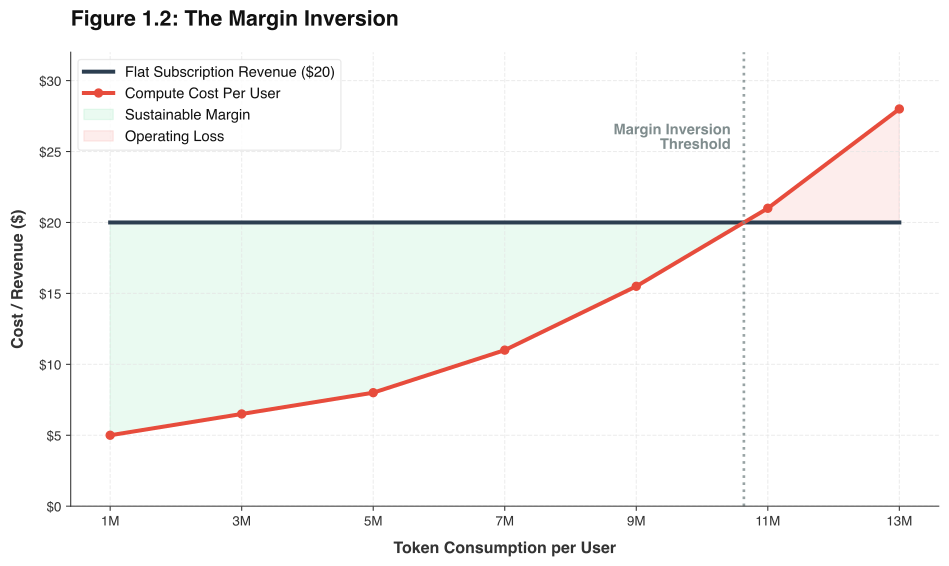
This specific divergence reveals exactly where the false equivalence becomes visible to infrastructure planners. When AWS charges an enterprise for standard compute capacity, the cost of serving one additional customer remains nearly constant because the underlying computation is entirely deterministic. A given Lambda function executes the exact same machine instructions regardless of how many thousands of customers are concurrently using the platform. When Netflix streams high-definition video to a new subscriber, the marginal cost per additional viewer is negligible because the digital content is already pre-encoded and globally cached at the edge. The supporting infrastructure scales predictably alongside the revenue.
Artificial intelligence does not operate on this historical curve because the cost of a single inference call is never constant, as it depends entirely on the volume of contextual data the statistical model is instructed to process during execution. An autonomous agent navigating a small, well-bounded, modular microservice generates a completely different financial cost profile than the exact same agent attempting to navigate a sprawling, deeply entangled monolith, even when both agents are solving the exact same type of logical engineering problem. The financial cost is a direct function of the raw context volume required to execute the specific task as opposed to a function of the number of users interacting with the system in traditional SaaS.
Figure 1.3
The AI Scaling Anomaly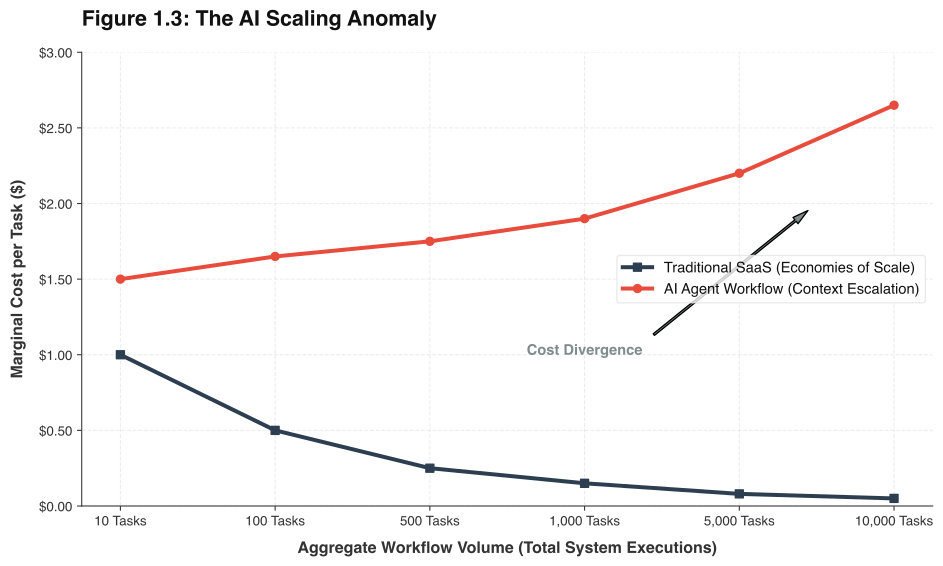
This crucial distinction invalidates the standard industry playbook for enterprise cost management and the predictable justifications around it. Traditional cloud financial operations operate on the assumption that infrastructure costs are a direct function of scale and can therefore be optimized through careful capacity planning and system design. If AI costs are instead a function of what the machine is explicitly asked to process, the optimization target must change. The primary financial variable is no longer how many developers are permitted to use the tool, but rather the structural environment and architectural topology the tool is forced to operate within.
A Familiar Economic Pattern
As we’ve seen just now, the underlying economics of generating machine inference may be quite different in their specific mechanical operation, but the software industry’s reaction to them follows a strictly predictable, almost cyclical historical pattern. We’ve seen this reaction before.
Whenever the software industry encounters a big leap in available compute power, the immediate initial instinct of the engineering floor is to utilize that new brute force capability to mask underlying structural complexity and bypass necessary architectural rigor. This specific behavioral pattern has occurred during every major platform shift. When companies first initiated the mass migration to cloud infrastructure, engineering teams spun up virtual servers endlessly because the available infrastructure felt effectively infinite compared to physical data centers. Organizations routinely provisioned capacity far beyond what their actual workloads required simply because the marginal cost of provisioning each additional instance appeared negligible in the moment. It was only after massive, unexpected financial bills arrived from the infrastructure providers that the industry was forced to establish the rigorous discipline of cloud financial operations, requiring engineers to stop blindly buying excess capacity and start aggressively optimizing their actual resource consumption. This gave birth to virtualization, containerization, autoscaling, serverless computing, etc.
This exact same psychological pattern occurred even earlier during the initial web scaling era of the early 2000s. Instead of taking the necessary time to carefully optimize database schemas, build efficient indices, and analyze query execution plans, companies frequently chose to purchase larger, vastly more expensive hardware servers. They applied raw, brute-force infrastructure to the problem until the compounding hardware costs became mathematically unsustainable for the business to support. Engineering teams were subsequently forced, under extreme financial duress, to invest in the fundamental structural optimizations like indexing strategies, complex query planning, and rigorous schema normalization that should have been implemented from the very beginning of the project lifecycle.
Every single infrastructure cycle follows the exact same predictable sequence. A massive surge in cheap, subsidized compute arrives on the market, engineers enthusiastically use it to avoid difficult structural optimization work, operational costs eventually explode as the subsidies disappear, and a brand new optimization discipline is born to manage the fallout.
Figure 1.4
The Historical Optimization Loop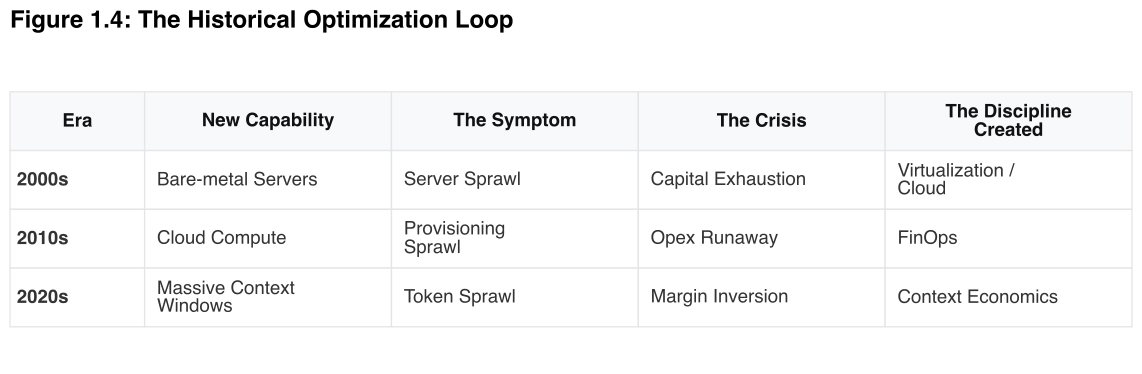
Today, the software industry appears to be repeating this historical pattern. Engineering teams are casually applying massive, highly expensive context windows to structurally complex, deeply entangled repositories, mirroring the exact way they once applied massive physical servers to unoptimized relational databases. During the extended period when machine inference was effectively free, developers rarely took the time to isolate specific application modules or trace execution paths manually before engaging the AI. They simply fed entire system directories into prompt windows and allowed the underlying model to sift through the raw noise to find the relevant syntax. This careless behavior was entirely rational while the massive computational cost was heavily subsidized by the platform provider. Now that the monthly invoices reflect actual, unvarnished token consumption, the engineering habits normalized during the period of artificial abundance are buckling under severe financial pressure.
The historical parallel strongly suggests that a dedicated optimization discipline will inevitably follow this crisis. Just as unchecked cloud sprawl eventually forced the creation of FinOps to manage AWS bills, the current escalating trajectory of machine inference costs points directly toward a necessary reckoning with whatever underlying structural property is driving the massive variance in API invoices.
The historical parallel also reveals a critical, unresolved difference in the optimization target itself. Cloud financial operations successfully optimized a well-understood variable by specifically targeting infrastructure provisioning and instance sizing. In the current situation involving AI, while prompt caching, model routing, history compression, effectively help in reducing raw token consumption but the consumer-side optimization target remains opaque. The enterprise invoices show undeniable variance between identical teams, but the physical property of the engineering environment that is actually creating that variance has not yet been isolated or defined by the industry.
The Variance Nobody Can Explain
As large technology organizations begin enforcing strict token budgets to control runaway costs, use tips and tricks to save tokens, a glaring discrepancy is emerging across the industry that existing financial cost models cannot resolve or explain. When carefully analyzing the internal usage dashboards of different engineering teams operating within the exact same enterprise environment, the token consumption rate rarely correlates directly with the actual complexity of the features being shipped to production. Two highly competent engineering teams can be tasked with building nearly identical features, using the exact same underlying foundational models and identical agentic deployment tooling, yet one team will consistently exhaust their allocated token budget at a dramatically higher rate compared to their peers.
The immediate instinct of engineering leadership is usually to attribute this discrepancy to variations in user behavior or subtle vendor configuration settings, or prompt engineering skills. The standard industry explanations typically focus heavily on differences in prompt engineering skills among developers, hidden variations in model pricing tiers across different organizational units, or a general lack of developer training regarding strict context window management. While these factors certainly influence the margins of the final invoice, they appear mathematically insufficient to explain the sheer, multiplicative scale of the observed discrepancy. A slight semantic difference in prompt structure cannot plausibly account for why an autonomous agent requires ten times as many API calls and millions of additional tokens to trace a basic execution path in one project compared to another project of comparable size and logical complexity. The mathematical gap between the standard industry explanations and the actual observed financial variance indicates that a highly significant variable is being overlooked entirely by current telemetry tools.
During initial investigations conducted across a limited corpus of five distinct repository sizes, the scale of this divergence became measurable. When observing identical AI agents executing highly comparable engineering objectives across completely different repository environments, the resulting token consumption routinely diverged by margins sometimes exceeding 30%. The agent architecture and the model configurations remained the same throughout the observation period. The difference was the physical, topological structure of the codebases the AI agents were instructed to navigate. These initial findings were compelling enough to motivate a fully controlled experiment, though they were not sufficient to constitute a rigorous proof by themselves.
Figure 1.5
The Unexplained Variance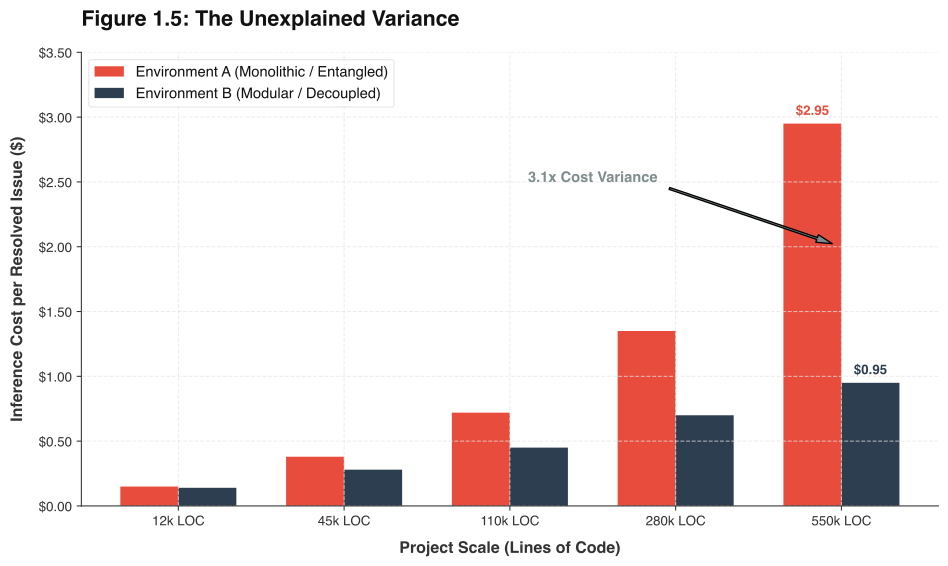
The failure telemetry extracted from these runs provided additional and revealing signals. When an autonomous AI agent ultimately failed to complete its assigned engineering task, the agent operating within the fragmented repository environment consistently consumed significantly more tokens before finally reaching the failure state. The agent consumed drastically more compute, failed to successfully compile the required logic, and exhausted its operational budget much faster than its counterpart. If the observed variance affected only successful executions, it could perhaps be dismissed as a minor optimization opportunity for the engineering floor. The undeniable fact that repository architecture also amplifies the financial cost of failure suggests that a deeper, systemic structural mechanism is at play.
If the integrated AI tools are identical, the human developers are equally capable, and the foundational models operate on the exact same tier (model) of intelligence, the true source of the variance must reside elsewhere in the system, perhaps the repository. To rigorously test whether the physical architecture of the code itself was actively causing this financial bleed, I needed to move away from preliminary field telemetry and transition into a strictly controlled engineering laboratory environment.
While reviewing the raw agent execution logs,I assumed that the most prominent data point was going to be the final token count, but rather it turned out to be the repetitive, looping nature of the failures themselves. When an AI agent fails to resolve a logical issue and reaches its maximum context window limit repeatedly, the internal telemetry reveals a highly specific physical traversal pattern. The agent enters recursive search loops, continuously re-reads the same foundational dependencies, and opens entirely unrelated files in an attempt to construct a coherent dependency map of the system. This chaotic traversal pattern appears most frequently when the relevant business logic is scattered across disconnected directories or buried deep within structurally entangled file hierarchies. The model fails because it physically cannot locate the scattered dependencies required to assemble the necessary context window, irrespective of how complex the underlying business logic is complex or conceptually difficult to grasp.
The Economic Bridge
The widespread introduction of agentic AI development tools has introduced an economic variable that the software industry currently lacks the diagnostic instruments to properly measure or manage. Because the cost of operating enterprise software has historically been tied directly to compute cycles, memory allocation, and human engineering salaries, these three foundational pillars formed the basis of engineering economics for decades. If a specific repository structure was deemed inefficient, it either consumed excess server capacity in production or required excess human hours to untangle during maintenance cycles. The appropriate engineering response was always clear, prompting teams to either optimize the underlying cloud infrastructure or aggressively refactor the codebase to improve human readability. Both the nature of the problem and the specific optimization target were exceptionally well understood by engineering leadership, and it made perfect sense.
However, Machine-assisted development changes this economic equation where engineering teams are no longer evaluating repositories based solely on how efficiently a compiler can execute the syntax or how easily a junior human developer can read the logic. They are now forced to observe how efficiently an AI model can autonomously navigate the architecture of the codebase itself. A specific repository architecture might be highly performant in a production environment and perfectly scalable under massive concurrent user load, yet if its deeply nested internal structure forces an autonomous agent to consume a maximum context window simply to map a basic state change, that architectural structure acts as a severe, and an active financial liability to the organization.
If the physical structure of a repository actively influences the raw cost of machine comprehension, then machine-comprehension cost may need to be measured as a secondary engineering constraint, sitting carefully alongside the primary historical goal of human maintainability. This assertion does not suggest that repositories should be optimized exclusively for machines at the expense of developers, that would be absurd. Human maintainability remains the primary, non-negotiable architectural objective, as software systems are ultimately built, debugged, and expanded by human engineers. However, if machine-comprehension cost is real and systematically measurable, then engineers need the necessary instrumentation to observe and optimize it without compromising human readability.
The software industry currently lacks that critical instrumentation. An API invoice differs dramatically from team to team, but the generated invoice is the financial shadow of a complex physical process that remains unobserved by the engineering floor. An invoice tells an engineering team exactly how much capital they spent on AI during a billing cycle. It does not explain why one repository structure consumed three times the tokens of another for the exact same engineering task. It also does not identify the specific architectural boundaries where the agent entered recursive failure loops, or which massive files it opened unnecessarily during its search, or how many directory traversal attempts returned completely null results.
So, to truly understand the root cause of this emerging economic anomaly, the investigation must transition from observing the surface-level of the invoice to analyzing the physical mechanics of the traversal an an AI agent itself. If it requires significantly more computational effort for a machine to navigate certain architectural codebases, the physical execution of that effort must be meticulously documented and quantified. The investigation requires a methodology to observe exactly how an autonomous agent physically navigates a repository when the underlying business logic is held constant across different environments.
With the foundational model, the autonomous agents, and the engineering tasks completely standardized and locked in place, the repository architecture remains the isolated variable across the corpus. I invite you to join me on this investigation where we will form a comprehensive working hypothesis regarding how a machine physically perceives the structure of a codebase, and we will test this hypothesis against hard data.