The Mechanics of Machine Comprehension
How AI coding agents read, search, and navigate unfamiliar codebases.

Lead Software Engineer & Systems Architect
- Understanding repository structure as physical terrain for autonomous agents.
- The mechanics of exploratory traversal: why agents spend 80%+ of tokens before writing code.
- The Visibility Gap in engineering telemetry and the need for new instrumentation.
The Economics of Machine Comprehension Part 2: Why it matters how AI agents acquire context before they can write software.
The initial investigation identified an economic anomaly in modern software development. The transition from flat subscription models to usage-based billing exposed the raw cost of machine inference, but it failed to explain why those costs hit identical engineering departments with such unequal severity. Two teams using the exact same language models and identical agentic tooling to build comparable features frequently generate API invoices that differ by a full order of magnitude.
When confronted with budget overruns, technology leadership teams predictably reach for standard financial controls. They restrict developer seat licenses, implement governance layers, and enforce hard monthly spending limits, enroll developers into prompt-engineering certifications or run workshops that promote tips and tricks to save token. These administrative reactions while helpful, only treat the financial symptom without addressing the route cause. They operate on the assumption that extreme token expenditure is driven strictly by poor developer habits, bad prompting, or vendor pricing strategies. This investigation looks in a different direction. To understand why one repository costs a machine significantly more to read than another, it is necessary to form a working hypothesis about how an AI agent navigates a software project.
The Repository As Terrain
When an autonomous agent resolves a software task, it does not read the codebase the way a human programmer does. To a machine, a repository is a collection of disjointed text files rather than a cohesive logical narrative. To understand the variance in execution costs, it is necessary to visualize the repository as a database of raw text. Directories act as boundaries and dependencies act as explicit links between files. When an agent attempts to map a system state, it executes discrete shell commands to traverse this structure. It runs searches to find entry points, reads files to trace execution paths, encounters missing references, and runs new searches to acquire the necessary context.
For an experienced human engineer, jumping between five separate files to understand how a payment gateway logs an audit event is a minor inconvenience. The human brain holds the higher-level abstraction, using semantic memory to bridge the gaps between files, it’s billions of years of evolution at work. For a language model constrained by a context window, those five files represent a sequence of required API calls. The agent must issue a command to search the directory, wait for the path, issue another command to read the file, ingest the text, and calculate whether the text contains the required information. Each of these steps requires what i refer to as an independent inference cycle, and each cycle consumes tokens. What a human developer processes as a quick conceptual leap, the machine executes as a sequence of distinct, token-heavy API calls.
The Mechanics of Context Acquisition
A working hypothesis for this process is that the AI agent interacts with the repository by building attention matrices across a limited context window. This means the model is attempting to mathematically link a variable declared in one file to an interface located three directories away. When the required business logic is localized within a single module, this mapping process requires minimal compute. The relevant syntax sits close together within the context window, and the relationship is established efficiently.
But, when a software repository suffers from structural entanglement, related logic is scattered across dozens of disconnected files. In these fragmented environments, the agent faces a context acquisition burden. To bridge the gap between these architectural boundaries, the machine ingests massive amounts of irrelevant code simply to map the directory structure, and acquiring this context is a repetitive loop that dominates execution time.
Figure 2.1
The Context Acquisition Loop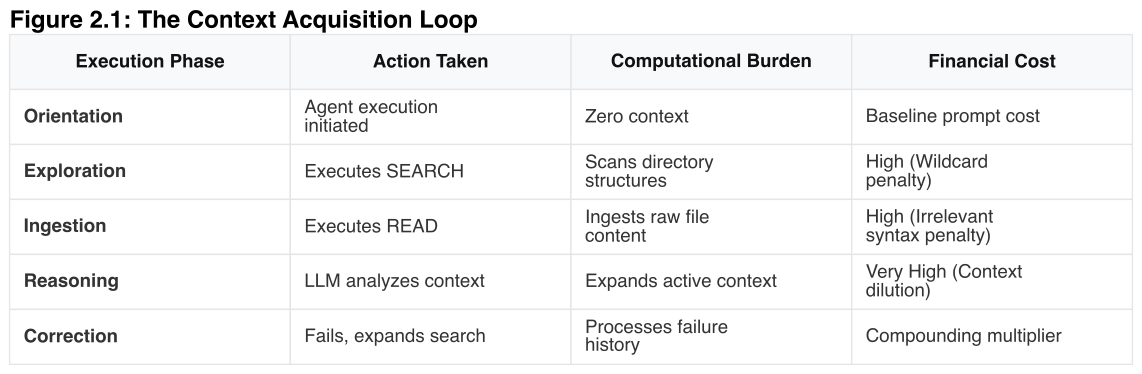
If structural entanglement forces an agent to repeatedly flood its context window with irrelevant syntax, it is necessary to determine if repository fragmentation merely increases the baseline financial cost of a task. The critical question is whether scattered information/code degrades the model’s ability to generate accurate outputs, potentially inducing search failures and exhausting the token budget before the agent can write the required code. Now, we have a testable prediction.
Figure 2.2
The The Economics of Machine Comprehension Causal Chain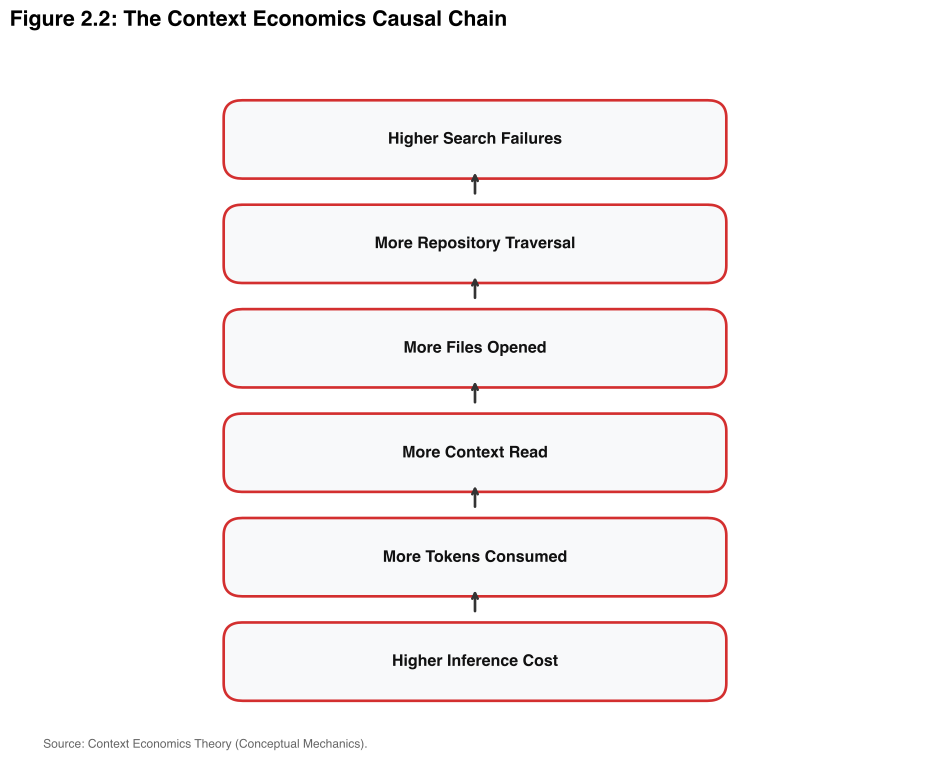
The Traces of Traversal
When an AI agent maps dependencies across a fragmented repository, its execution leaves a clear record in the system logs. Every directory listing requested and every repetitive file read executed generates measurable data. By analyzing this data, it is possible to isolate the specific metrics that increase when an agent navigates a complex architecture. It is possible to measure the variance in the absolute number of API calls required to complete a task. It is possible to track the cumulative input and output token volume consumed across those cycles. Finally, it is possible to log the total execution time the agent required to resolve the issue.
When reviewing a routine feature request that exhausted its maximum context window, the raw terminal logs revealed a highly repetitive pattern.
Figure 2.3
The Execution TraceWatching this specific trace unfold in real-time was an important moment in the investigation; it gave me assurance that I was looking in the right direction. It became apparent that the agent was not failing to write code, but was simply lost in the directory structure. It’s an important distinction.
So, if the architectural structure of the repository dictates the processing required to navigate it, this traversal burden should compound as the repository scales, naturally. But, in a small codebase, an autonomous agent locates scattered dependencies within two or three search steps. In a large enterprise system containing thousands of files on the other hand, the exact same scattering pattern forces the agent into a recursive loop, consuming tens of thousands of tokens per step simply to map the directory tree.
Figure 2.4
Context Acquisition Cost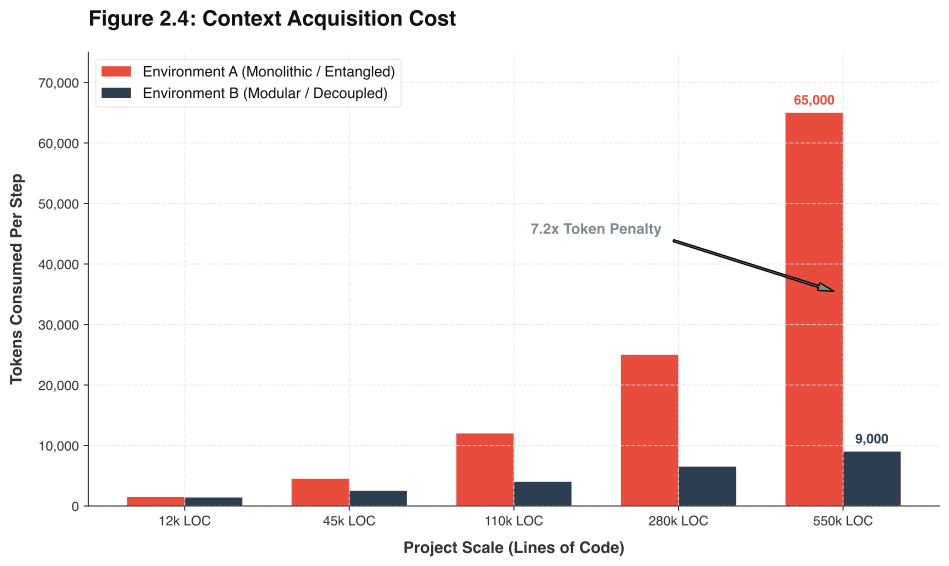
This focus on tracking execution data does not imply that human-centric metrics are obsolete. Code legibility and cleanly bounded semantic interfaces remain the primary design objectives for any software architecture. Software systems are built for human engineering teams, not for statistical models. But, human-centric measurements do not account for machine execution costs. A specialized interface might appear perfectly logical to a human developer who understands the undocumented history of the codebase. That exact same architectural structure/design forces an autonomous agent to execute dozens of search commands only to map the references. If machine-comprehension cost operates as a parallel engineering constraint, the industry requires a separate set of operational indicators to track it.
The Visibility Gap
The software industry manages artificial intelligence integration through lagging financial indicators where engineering organizations review their monthly cloud spend or track overall token usage on vendor dashboards. The financial cost of inference is fully observable on the balance sheet. What the industry cannot currently observe is the specific execution behavior that produced those costs. While it is possible to manually scrape a terminal log to debug an isolated agent run, there is a lack of systemic instrumentation to track traversal paths across an enterprise deployment. It is impossible to see the search failures, the unnecessary directory exposure, or the escalating context acquisition burden in real-time. We cannot optimize a process that we cannot systematically measure.
When two engineering teams utilizing identical language models generate entirely different cost structures for comparable features, the financial discrepancy is visible but the underlying root cause remains speculative in the absence of hard data. Our experiments aim to prove that Environment A structurally forces the agent to execute more API calls and jump between more directories than Environment B, but without systematic measurement, this remains an unproven assumption.
Figure 2.5
Spatial Latency vs. Operational Cycles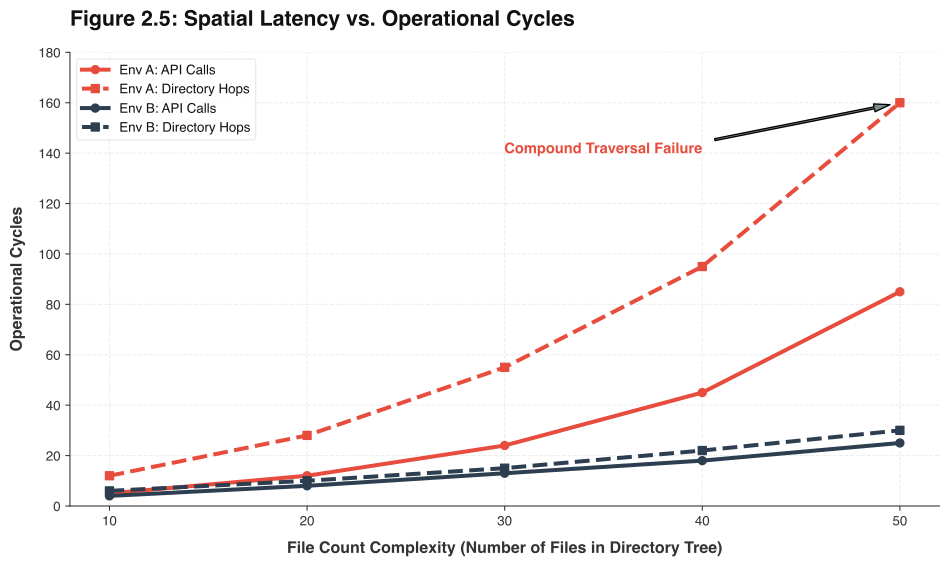
Without visibility into the specific folder exposure or the traversal trajectories of the agent, we cannot definitively diagnose why one codebase accelerated the machine while another forced it into an expensive recursive loop. Now, we have the theoretical mechanics in place. Structural entanglement forces these systems to consume massive token volume to map fragmented architectural boundaries. This processing requirement is expected to generate measurable data in the form of API cycles and compounding token volume.
Now we know that the execution costs exist within the repository. Without a systematic, repeatable way to categorize these raw terminal commands and measure their cost, the mechanics of the process remain completely obscured. If agents are forced to physically traverse the repository, the immediate challenge is: can we actually observe them doing it?