The Standard
Architectural principles and engineering standards for the era of AI-assisted software delivery.

Lead Software Engineer & Systems Architect
- The Machine Comprehension architectural standard for dual human and AI velocity.
- Practical rules for boundary colocation, context budgeting, and semantic anchors.
- The research roadmap and open apparatus for the global software engineering community.
In the early development of structural engineering, builders relied heavily on intuition, observation, and catastrophic failure to determine the load-bearing limits of a bridge. It was only when those raw observations were codified into mathematics, standardized into metrics, and published for rigorous peer review that structural engineering transitioned from an artisanal craft into a formal, reproducible discipline.
The software industry is currently navigating a similar transition regarding artificial intelligence. We have observed that autonomous agents fail in certain architectural environments. Over the course of this investigation, we’ve tracked the execution traces, mapped the token consumption, and documented the severe financial consequences of traversal overhead. However, isolated private observation doesn’t constitute a formal engineering discipline.
For The Economics of Machine Comprehension to mature into a formal branch of software architecture, or even a discipline, it must move beyond controlled laboratory observation and be subjected to public falsification. The instrumentation, the metrics, and the underlying data must be open-sourced, rigidly defined, and entirely reproducible by any engineer or a team or an organization. Because this architectural phenomenon is real and financially impactful, the Context Economics Benchmark (CEB) must now be subjected to independent verification. The accumulated weight of the evidence demands a complete, open ecosystem for measuring the physical cost of machine comprehension.
The Requirements of a Discipline
A scientific discipline requires a shared language, a standardized unit of measurement, and a physical apparatus capable of reliably capturing those measurements across disparate environments. Without these three foundational pillars, discussions regarding artificial intelligence coding efficiency remain entirely anecdotal and subjective.
Throughout this investigation, the generated telemetry has consistently demonstrated that machine-comprehension cost is an active, and measurable property of software systems. We have seen that identical agents solving identical tasks incur vastly different computational and financial costs depending on the physical proximity of the code they are forced to navigate. However, a single laboratory demonstrating this anomaly is insufficient to alter industry best practices.
To systematically verify that the scaling laws of The Economics of Machine Comprehension hold true across the broader software industry, independent developers must be able to replicate these findings. Engineering teams need the ability to run autonomous agents against their own proprietary codebases, utilizing disparate foundational models, to generate comparable telemetry. Achieving this level of independent validation requires formalizing our laboratory apparatus into a public standard.
The Research Ecosystem
The The Economics of Machine Comprehension apparatus emerged organically from investigative necessity, and a general feeling of ‘this can’t be all of it’. Measuring architectural friction was effectively impossible without first building a collection of open methodologies and custom parsers designed to convert chaotic agent execution logs into structured financial telemetry.
Figure 6.1
The The Economics of Machine Comprehension Ecosystem Pipeline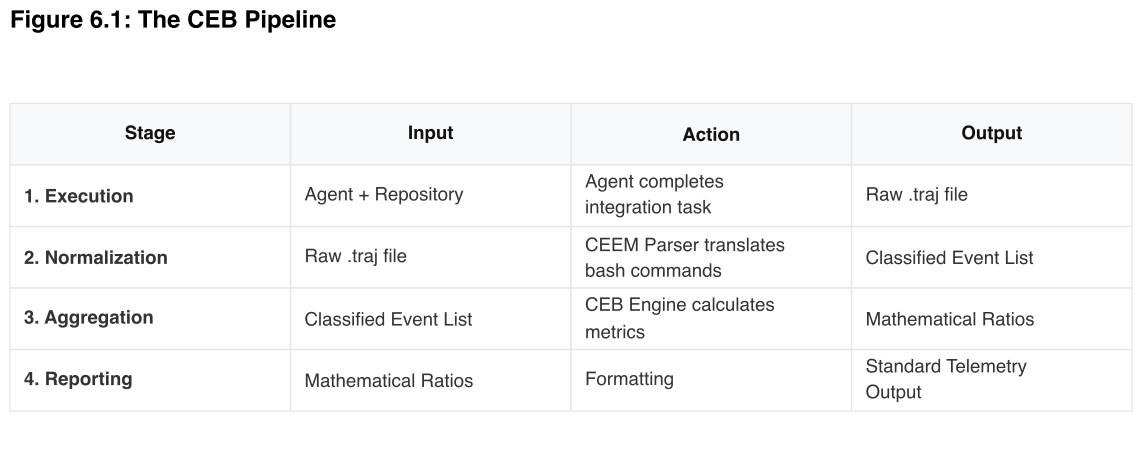
It is necessary to reiterate the foundational boundary established during the interpretation phase: the CEB measures machine traversal efficiency rather than grading architectural quality or design patterns. It is designed to be used as a diagnostic instrument to understand friction, and should never be viewed as an optimization target intended to supersede human readability.
These core components reached their current form through extensive iteration, with specific metrics being added, discarded, and refined as the evidence dictated. Because independent replication requires access to the exact tools used in the laboratory, the following foundational components have been formalized for immediate public use.
1. The Context Economics Event Model (CEEM)
The core enabler of this discipline is a standardized taxonomy for machine behavior. Before we can accurately measure friction, the nearly infinite variations of agent terminal commands must be normalized into a finite set of physical actions. The CEEM framework establishes eight baseline events: SEARCH, READ, CREATE, MODIFICATION, TEST, BUILD, SUBMIT, and SYSTEM. This shared operational language allows an engineer utilizing a custom shell script to compare their agent telemetry directly with an engineer utilizing a commercial development plugin.
2. The CEB Parser and Normalization Engine
To operationalize the event model, I required the development of the CEB Parser. This engine reads unstructured .traj or .txt execution logs, identifies the underlying intent of the machine command, and translates it into standardized CEEM events. Across the Initial Reference Corpus, the parser achieved an impressive 98.4% classification rate, with only 1.6% of terminal outputs returning an UNKNOWN classification requiring human review.
Figure 6.2
The Parser Translation Output3. The Initial Reference Corpus
I have released the exact codebase configurations used in the Case Study 3, which is supposed to function as the mid-ground and an ideal representative to view this change without wasting significant tokens. This will allow developers to run a sample test before examining the benchmark and potentially wasting tokens and money, it will be a full guide you can follow. Though I will not able to able to publish all of the repositories on github as they are private repositories, but I plan to run these tests on open source repositories and then build colocated versions of them to test my benchmark and refine it along the way.
4. The Formal Telemetry Definitions
Finally, I have published the mathematical definitions of the core The Economics of Machine Comprehension metrics. The Exploration-to-Modification Ratio (EMR), Repository Traversal Cost (RTC), First Modification Latency (FML), Search Failure Rate (SFR), and Task Resolution Rate (TRR) serve as the standardized units of measurement for evaluating context architecture across the industry.
By releasing this entire ecosystem, the engineering community receives the apparatus required to measure the traversal overhead that their architectures impose on autonomous agents. However, while this apparatus provides visibility, I must also be completely transparent regarding its current limitations.
The Limits of the Current Apparatus
In any emerging scientific discipline, maintaining intellectual honesty regarding the limitations of the initial laboratory apparatus is just as critical as publishing the findings themselves. If the engineering community is to adopt the Context Economics Benchmark (CEB), the boundaries between systematic data and future extrapolation must be defined. The Initial Reference Corpus and the associated case studies operate under several boundary conditions that require expansion by future research.
1. The Single-Agent Constraint
The initial laboratory relied on a specific, custom-configured autonomous command-line agent. While this agent utilizes standard ReAct (Reasoning and Acting) loops and execution tools common to the industry, the CEB has not yet been executed against the massive array of commercial agents currently on the market. I will keep updating this benchmark as I figure out how this can be tested beyond SWE-agent environment, and which metrics can be extracted to comply with The Economics of Machine Comprehension benchmark metrics. It is highly probable that distinct agentic architectures possess unique traversal behaviors that will inevitably alter the baseline EMR and RTC measurements.
2. Foundational Model Uniformity
The experiments held the foundational model constant in order to isolate architectural friction. Sufficient data does not yet exist to understand how the raw reasoning capacity of a specific AI model impacts the Search Failure Rate (SFR). A model possessing superior semantic deduction might navigate a fragmented architecture with a significantly lower SFR, though I hypothesize that the physical token penalty will remain universally high.
3. The Absence of Human Correlation Data
The telemetry clearly indicates that fragmented architectures impose cognitive and financial penalties on machines. However, the Context Economics Benchmark does not currently attempt to measure human comprehension cost. The Human Primacy Principle should and does dictate that repositories must be optimized for humans first, yet data proving that a high machine-comprehension cost correlates directly with a high human-comprehension cost does not yet exist. Many anecdotal engineering experiences strongly suggest the correlation is real, but it remains unproven.
4. Statistically Limited Corpus Size
The Initial Reference Corpus consists of five architectural scales ranging from 12,000 to 550,000 lines of code. While this was sufficient to map a consistent, non-linear scaling pattern in context acquisition cost, a sample size of five is simply not statistically definitive for the global software industry. The corpus requires quite an expansion to ensure these curves hold true across a much wider array of architectural paradigms. I’ll keep working on that, hopefully the engineering community finds this interesting enough to help me accumulate the data required.
5. The Lack of a Negative Control
The experimental design lacked a strict negative control mechanism. For example, running the agent against a completely flat, non-code text repository (such as a library of plain-text legal documents) would definitively isolate whether the token overhead is specific to code-boundary fragmentation, or merely a byproduct of raw token length regardless of semantic content.
Figure 6.3
The The Economics of Machine Comprehension Maturity Roadmap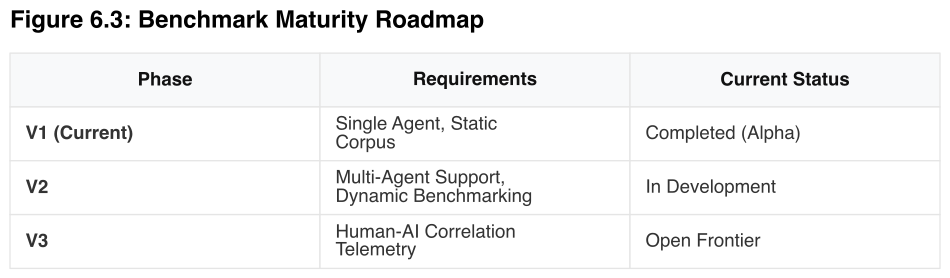
These limitations represent the exact research boundaries that I must now cross. They provide the roadmap for the next generation of The Economics of Machine Comprehension investigation.
The Open Frontier
The Economics of Machine Comprehension was established to address a systemic problem: inference bills for AI agents scale unpredictably, and the industry lacks the vocabulary to explain exactly why this occurs.
This investigation brings that invisible friction into the light. The data demonstrates that the physical structure of a software repository operates as a compounding economic variable rather than just an aesthetic preference. We have mapped the anatomy of a search failure, quantified the explosive cost of Traversal Overhead, and established the vocabulary necessary to diagnose the problem at scale. The initial laboratory phase is now complete. Whether this ultimately constitutes a formal engineering discipline is a verdict that belongs to independent replication.
Figure 6.4
The Next Generation of Telemetry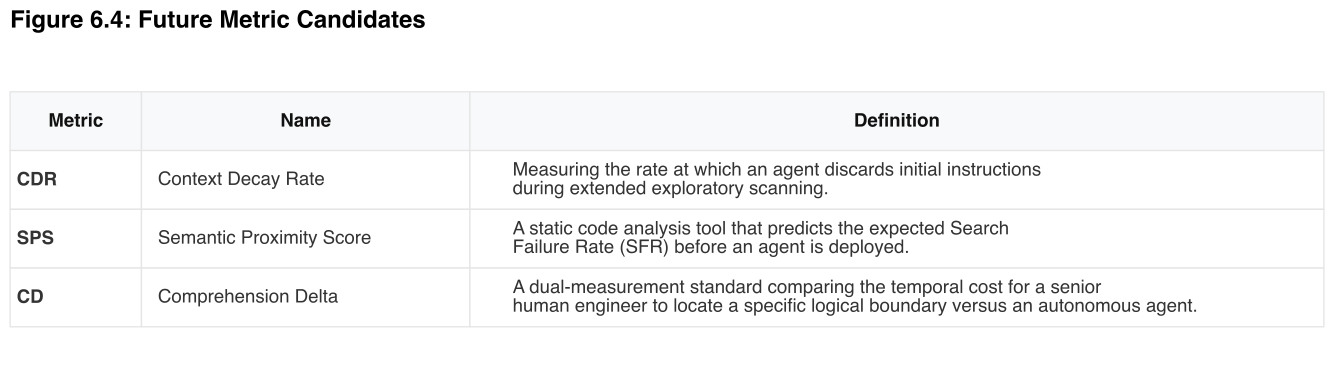
Context Decay Rate (CDR): Measuring how rapidly an agent discards initial instructions when forced into deep exploratory loops.
Semantic Proximity Score (SPS): A static code analysis metric that predicts the expected Search Failure Rate (SFR) before an agent is deployed.
Comprehension Delta (CD): A dual-measurement standard comparing the time required for a senior human engineer to locate a specific logical boundary versus an autonomous agent.
Simultaneously, the Initial Reference Corpus requires vast expansion beyond its current boundaries. We now need an investigation into new architectural topologies. The community must determine if a strictly typed language enforces structural boundaries that inherently lower the machine-comprehension cost compared to dynamically typed languages. We must also also determine if massive Monorepos generate a significantly different Exploration-to-Modification Ratio than Polyrepos for cross-service integration tasks.
I would like to actively invite the software engineering community to stress-test this entire apparatus, as I will also continue doing so. Engineers are encouraged to run the CEB Parser against their internal execution logs, apply the CEEM taxonomy to their agent architectures, and run agents against the Initial Reference Corpus to test the baseline metrics.
Most importantly, I invite the community to attempt to falsify the data. The findings documented in this investigation would be challenged by any research showing a fragmented repository consistently producing a lower RTC and SFR than a colocated equivalent under controlled conditions. Similarly, if Traversal Overhead scales linearly with repository size, or if an agent navigates deeply entangled architectures without incurring token overhead, the framework must be revised.
Science is built on the rigorous, public testing of hypotheses, and if the telemetry continues to hold true, The Economics of Machine Comprehension will change how the industry architects software in the age of artificial intelligence. If it fails, the community will use the data to build a significantly better benchmark, either way, it’s a win-win. In either scenario, the physics of context acquisition are observable, measurable, and highly expensive.
I’m open to any questions regarding the benchmark and any suggestions to improve it.